The adaptive target
Not a formula. A measurement.
Every calorie app starts you on a formula. Teller starts there too, then replaces the number with one measured from you. This is how that works, what it needs from you, and where its limits are.
Why the formula is only a guess
The usual starting point is the Mifflin-St Jeor equation: your sex, age, height and weight give a resting rate, and an activity multiplier you pick yourself scales it up. It is the best population estimate we have, and for a population it works. For one person it is a guess. Two people with the same numbers on the form can differ by several hundred calories a day, and the activity multiplier is a self-assessment on a five-point scale.
Most apps hand you this number on day one and never revisit it. When the weight does not move, the app cannot tell you why, because it never checks.
The idea: energy balance
What you eat minus what you burn is what your body stores or gives up, and that shows on the scale. Roughly 7,000 kcal correspond to one kilogram of body weight. So if you know what you ate over a stretch of days and how your weight moved, you can solve for the one thing you cannot measure directly: what you burn. Eat 2,300 a day and hold your weight, and you burn about 2,300. Eat 2,300 and lose a quarter kilo a week, and you burn about 2,550.
That is the whole trick. It is not new, and MacroFactor has done it well for years. What differs is how each app handles the noise.
Weight is noisy, so Teller smooths it
Day to day, your weight swings by up to a kilo for reasons that have nothing to do with fat: water, salt, glycogen, what is still in your gut. Taking any one reading seriously would swing your target around for nothing. Teller runs a Kalman filter over your intake and your weigh-ins. It carries two numbers along, a trend weight and an expenditure, predicts where both should be tomorrow, and corrects both whenever a new weigh-in comes in. A day without a weigh-in is a prediction without a correction. A day you mark as not tracked is filled in with a typical intake and treated with much more uncertainty.
The filter re-runs over your whole history every time, so correcting an old entry fixes everything that came after it. Nothing is baked in.
The weekly check-in
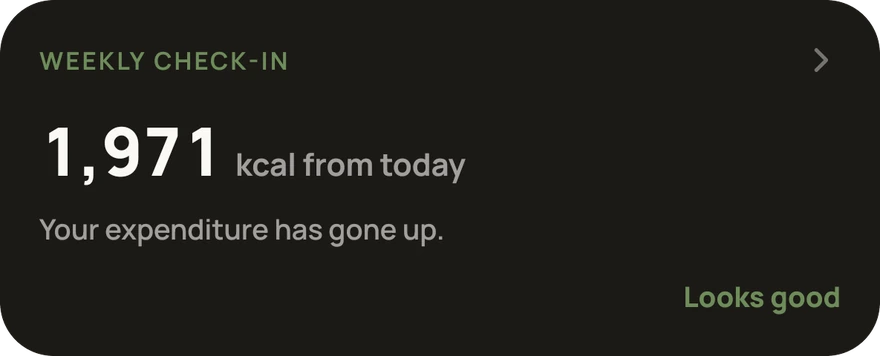
Once a week Teller compares the measured expenditure with your current target. It proposes a change only when two things hold: the measurement is more certain than the estimate it would replace, and the difference is worth acting on. Small drifts of a few calories are ignored, so the target does not twitch. When it does propose a number, it shows the reason: your expenditure went up, went down, or held steady. You accept with one tap, or keep the old target. If you set a target by hand, Teller keeps measuring but stops moving it.
What it needs from you
Log most days. Not perfectly, and not every day; a day you did not log is better marked as untracked than logged as zero. Weigh yourself regularly. Every second day is enough, and at that pace the first measured target arrives after about ten days. Until then you see the formula number and a progress ring telling you how far the measurement has got.
If you stop for a while, the measurement pauses. It does not reset and nothing is lost. A few logged days and it is sharp again.
Why your logging errors matter less than you think
Nobody logs perfectly. Portions get eyeballed, restaurant meals get guessed, photo estimates are estimates. The reassuring part: a consistent error cancels out. If you under-log by ten percent every day, the expenditure Teller measures is ten percent low too, and the target it sets is in the same units you log in. You still land where you should. What does hurt is changing how you log halfway through, because the measurement then has to relearn.
What it does not do
It does not import the calories your watch says you burned, and it does not sync with Apple Health yet. That is deliberate: wearable calorie figures are estimates, often generous ones, and they are the thing this measurement replaces. Your workouts are already in the number, because they are already in your weight.
It is also not medical advice. If you have a condition that affects weight or appetite, talk to someone who knows your history before you trust any app’s number, including this one.